
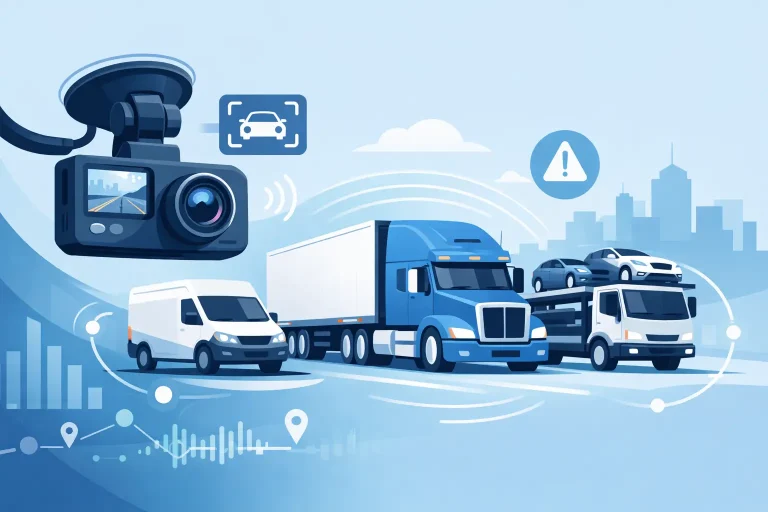
A near miss at 7:15 am can turn into a paperwork problem by 9:00. By lunchtime, it is a driver statement, a customer call, and a question from management about what actually happened. That is why AI dash cams for fleets are getting serious attention from operators who want fewer grey areas and better control over safety, claims, and day-to-day performance.
For most fleet teams, the appeal is not the camera itself. It is the ability to spot risk earlier, verify events faster, and spend less time chasing facts. When the right system is paired with telematics, driver behaviour data, and clear reporting, it stops being another device in the windscreen and starts becoming part of how the fleet runs.
What AI dash cams for fleets actually do
A standard dash cam records footage. An AI-enabled dash cam goes further by interpreting what is happening on the road and in the cab. Depending on the setup, it can detect harsh braking, tailgating, mobile phone distraction, driver fatigue signs, lane departure, speeding, and collision risks. Some systems also issue in-cab alerts so the driver can correct behaviour in the moment.
That difference matters. Reviewing hours of footage after an incident is useful, but it is still reactive. AI shifts part of the value forward. Instead of only documenting what went wrong, it can help reduce the chance of the event happening in the first place.
For fleet managers, that means less dependence on guesswork. If a vehicle is repeatedly generating distraction alerts, or if one route is producing frequent harsh braking events, you have something specific to act on. It becomes easier to coach drivers fairly, investigate incidents properly, and identify patterns that would otherwise stay hidden.
Why fleets are adopting them now
The pressure on fleet operations has changed. Safety expectations are higher, insurance costs are under scrutiny, and compliance teams are being asked to do more with less admin. At the same time, many businesses are managing mixed fleets with cars, vans, utes, trucks, trailers, and plant equipment spread across multiple sites and crews.
In that environment, visibility matters. Managers cannot be in every cab, and they should not need to be. AI dash cams provide a practical way to extend oversight without relying on constant phone calls, handwritten incident notes, or delayed reports.
There is also a commercial reason. Incidents are expensive even when they are minor. A small collision can trigger vehicle downtime, excess payments, rescheduling, customer delays, and internal admin. If camera footage helps resolve liability quickly, or if coaching reduces repeat risky behaviour, the system can pay for itself in ways that are not always obvious on day one.
The business case goes beyond footage
The strongest case for AI dash cams is usually not built on one headline feature. It comes from a mix of operational gains.
Safety is the obvious one. Real-time alerts can reduce distracted driving and other avoidable behaviours before they escalate. That matters whether you are managing metro service vehicles, long-haul freight, civil construction assets, or community transport.
Claims protection is another major benefit. When there is a dispute, footage provides context that driver recollection cannot always capture. It can show road conditions, surrounding traffic behaviour, and the sequence of events in a way that shortens investigations and supports insurers.
Then there is coaching. Good fleet operators know that driver improvement works best when it is based on facts, not assumptions. AI dash cams give supervisors actual examples to work with. That makes conversations more objective and often more productive. It is easier to support a driver when you can show the event, explain the risk, and track whether behaviour improves over time.
There is also a wider management benefit. When dash cam data feeds into the same platform as GPS tracking, utilisation, maintenance scheduling, and reporting, the fleet becomes easier to manage. Instead of one system for vehicles, another for cameras, and spreadsheets for the rest, you get a clearer operational picture in one place.
Where AI dash cams for fleets work best
These systems are especially useful where vehicles are on the road all day, where drivers work alone, or where incident exposure is high. Transport and logistics fleets are an obvious fit, but they are not the only ones.
Trades and field service businesses can use AI footage to support lone worker safety and verify what happened between jobs. Civil and infrastructure operators can use it to understand driver behaviour across changing road and site conditions. Community services and not-for-profit fleets often need accountability without adding heavy admin, which makes automated event capture particularly valuable.
That said, not every vehicle needs the same setup. A heavy vehicle on a regional route may need a different camera configuration and alert profile from a metro technician’s van. This is where many businesses go wrong. They buy based on features alone instead of matching the camera solution to the asset type, the operating environment, and the outcomes they actually need.
What to look for before you choose a system
The first question is not camera resolution. It is whether the system will be practical for your operation.
Start with visibility. You need clear video, reliable event capture, and footage that is easy to retrieve when something happens. If the platform makes managers jump through hoops to find clips, the value drops quickly.
Next is alert quality. Too few alerts and the system misses genuine risk. Too many and drivers start ignoring them, while managers get flooded with noise. The best setups allow thresholds and event types to be tuned to the fleet, not forced into a one-size-fits-all template.
Integration also matters. A dash cam that sits outside your broader telematics environment creates extra work. A system that aligns camera events with trip history, location data, and driver behaviour reporting is far more useful.
You should also look at support. Camera technology is only part of the equation. Installation, policy settings, driver onboarding, reporting setup, and ongoing troubleshooting all affect outcomes. Local support can make a real difference, especially when you are rolling out across multiple vehicles or sites.
The trade-offs fleet managers should think about
AI dash cams are not a set-and-forget fix. They work best when they are introduced with a clear purpose and a sensible policy framework.
Driver acceptance is one of the biggest variables. If cameras are presented as surveillance first, resistance is likely. If they are introduced as a safety and protection tool, backed by clear rules on how footage is used, the response is usually better. Most drivers understand the value once they see how footage can clear them of fault.
There is also a balance between oversight and admin. More data is not automatically better. If your team does not have a process for reviewing events, coaching drivers, and escalating genuine issues, the system can become another source of backlog.
Cost is another factor, but it should be looked at properly. The cheapest option can be expensive if footage is poor, support is weak, or integration is limited. On the other hand, a premium setup may be more than you need if your fleet risk profile is relatively simple. It depends on vehicle types, kilometres travelled, incident frequency, and how mature your fleet processes already are.
Making rollout easier for drivers and managers
A good rollout is usually straightforward. Explain why the cameras are being introduced, what behaviours they monitor, who can access footage, and how the information will be used. Keep the message practical. Drivers want to know whether the system protects them, whether false alerts can be reviewed, and whether they will be judged fairly.
Managers need a process as much as they need the hardware. Decide who reviews events, how often reports are checked, what triggers a coaching conversation, and which incidents need immediate follow-up. Without that operating rhythm, even a strong camera system will struggle to deliver consistent results.
This is where a solutions-led provider can make things much easier. The best outcomes usually come from combining AI cameras with tracking, driver behaviour reporting, and direct support rather than treating each tool as a separate project. For businesses that want fleet technology made ezi, that joined-up approach matters more than flashy specs.
The real value shows up in daily operations
AI dash cams do not replace good management, and they do not remove every incident risk. What they do is make the fleet easier to see, easier to coach, and easier to defend when something goes wrong.
For operational teams, that means fewer blind spots. For compliance and safety staff, it means stronger evidence and better follow-through. For business owners, it means more confidence that vehicles, drivers, and customers are being looked after with less wasted time around the edges.
If your fleet is still relying on phone calls, manual incident accounts, and delayed follow-up, the gap is probably larger than it looks. The right camera system will not just record the road ahead. It will give your team clearer decisions, faster action, and fewer avoidable surprises tomorrow morning.