
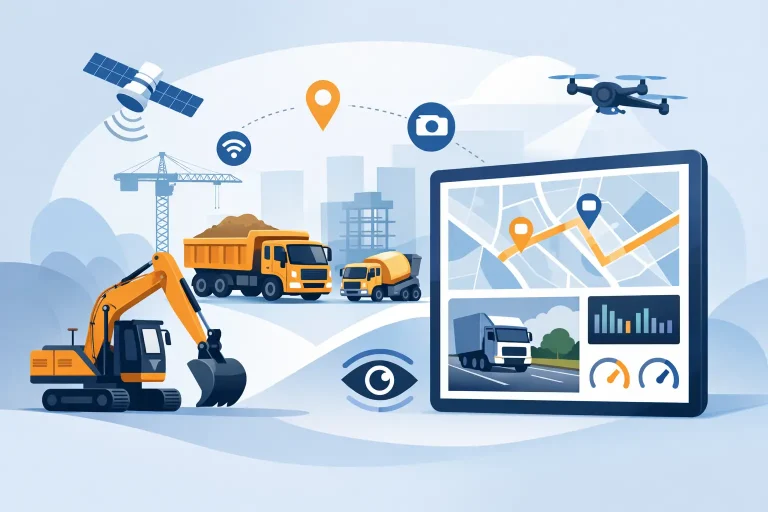
A construction vehicle can leave the yard compliant, fuelled and ready to go, then spend the day idling at a gate, taking an unapproved route, or arriving on site with no clear record of how it was operated. That gap between what should happen and what actually happens is exactly where IVMS for construction vehicles earn their place.
For civil contractors, plant operators, project managers and fleet teams, IVMS is not just about seeing dots on a map. It is about proving where vehicles have been, how they were driven, whether they met site entry standards, and how to reduce avoidable risk without adding more paperwork. When margins are tight and projects are heavily scrutinised, that kind of visibility matters.
What IVMS for construction vehicles actually does
An in-vehicle monitoring system collects data from the vehicle and turns it into practical oversight. In construction, that usually means GPS location, trip history, speed, harsh driving events, idling time, operating hours and, in some setups, driver identification, seatbelt status or camera footage.
The value comes from putting that information in context. A supervisor does not need raw data for its own sake. They need to know whether a water cart reached the right site on time, whether a ute entered a restricted area, whether a subcontractor vehicle met client compliance expectations, or whether plant utilisation is strong enough to justify keeping equipment on hire.
That is why IVMS has become common across projects with strict safety and reporting requirements. It gives construction businesses a clearer record of vehicle activity and a more reliable way to manage accountability across owned assets, hired equipment and contractor fleets.
Why construction fleets need more than basic tracking
Standard vehicle tracking can tell you where a vehicle is. That is useful, but construction operations usually need more detail than that.
A mixed fleet might include utes, trucks, service vans, light vehicles, yellow plant, trailers and non-powered assets spread across multiple sites. Some move all day. Others sit for long periods before being redeployed. Some need to meet client-specific access rules, while others are tied to internal maintenance and utilisation targets. A simple tracker will only answer part of the question.
IVMS for construction vehicles helps close that gap by combining location with behaviour, compliance and usage data. That makes it easier to manage three ongoing pressures at once – safety performance, operational efficiency and proof of compliance.
On a practical level, this can reduce the back-and-forth between office staff and crews. Instead of chasing drivers for trip details or relying on handwritten logs, businesses can pull consistent records from one platform. That is especially useful when projects involve principal contractor reporting, fatigue policies, remote travel requirements or disputed attendance on site.
Where IVMS has the biggest impact on site operations
The biggest gains usually come from small operational decisions made every day. When those decisions are based on real data rather than assumptions, scheduling and asset allocation get easier.
Better visibility across mixed fleets
Construction businesses rarely operate a neat, uniform fleet. A project may involve company vehicles, hired plant, subcontractor units and trailers all moving across different locations. IVMS helps operations teams see what is active, what is underused and what is where it should be.
That matters when you are trying to avoid unnecessary hires, redeploy equipment quickly or confirm whether an asset is sitting idle at a depot instead of working on site. Better visibility often leads directly to better utilisation.
Stronger driver and operator accountability
Driving behaviour affects fuel spend, wear and tear, safety outcomes and brand reputation. Harsh braking, speeding and excessive idling might seem minor in isolation, but across a fleet they become an avoidable cost.
IVMS gives managers a factual basis for coaching. It is not about catching people out for the sake of it. It is about spotting patterns early and addressing them before they turn into incidents, breakdowns or client complaints.
Easier compliance reporting
Many construction projects require documented evidence of vehicle movements, travel in remote areas, site attendance or adherence to safety standards. Pulling that together manually wastes time and leaves room for error.
With the right IVMS setup, much of that reporting becomes far more straightforward. Trip history, time on site, operating hours and exceptions can be reviewed without digging through paper forms, text messages and spreadsheet notes.
Safety is the real test of value
Every fleet technology provider talks about safety, but in construction the test is whether the system actually helps people make better decisions. A dashboard full of alerts is not useful if no one acts on it.
The practical safety benefit of IVMS is early visibility. If a vehicle is travelling outside approved hours, entering an unauthorised area or showing repeated harsh driving behaviour, the issue can be identified before it becomes something more serious. If combined with AI dash cams or fatigue-related reporting, the picture gets stronger again.
There is a trade-off here. More data does not always mean better safety. If the system is too complicated, alerts may be ignored and teams may lose confidence in it. The better approach is to focus on the measures that matter most to the operation – the ones supervisors can monitor and act on without adding another layer of admin.
Choosing IVMS for construction vehicles without overcomplicating it
Not every construction business needs the same level of monitoring. A contractor running ten utes across metro jobs has different needs from a civil company managing heavy vehicles, remote projects and client-mandated compliance. The right setup depends on the assets, the risks and the reporting obligations.
That is why it helps to ask a few grounded questions before choosing a system. Do you need basic journey tracking, or detailed behaviour reporting as well? Are you monitoring light vehicles only, or plant and trailers too? Will data be used mainly for internal efficiency, or does it need to support external compliance reporting? And just as importantly, who in your business will actually use the platform each day?
A system that looks impressive on paper can fall flat if it is difficult to deploy or too technical for the people relying on it. Ease of use matters. So does support. Construction operations move quickly, and when devices stop reporting or reports need adjusting, waiting days for help is not practical.
For many businesses, the sweet spot is a platform that covers multiple asset types, provides clear reporting, and is simple enough for office and field teams to use without heavy training. That tends to drive better adoption and better results over time.
Implementation works best when it solves a real operational problem
The most successful IVMS rollouts are tied to a clear business issue. Maybe site supervisors need accurate arrival and departure records. Maybe finance wants cleaner utilisation data to support billing and hire decisions. Maybe operations wants to cut idling and after-hours use. Starting with a real problem keeps the rollout focused.
It also helps to phase the implementation. Begin with the highest-value vehicles or the contracts with the strongest compliance requirements. Use the early data to set realistic benchmarks, train staff properly and refine reports before expanding across the broader fleet.
This is where a practical provider can make a real difference. Eziway Tech, for example, positions fleet visibility in a way that suits mixed asset environments rather than standard road fleets alone. That matters in construction, where businesses often need one usable system across vehicles, plant, trailers and mobile teams instead of a patchwork of separate tools.
The commercial case is broader than fuel savings
Fuel and maintenance reductions are often the easiest wins to explain, but the full return on IVMS usually shows up elsewhere too. Better utilisation can reduce unnecessary fleet growth. Accurate trip and hour records can support cleaner invoicing. Faster reporting can cut admin time. Stronger accountability can reduce disputes around vehicle use, site attendance and unsafe behaviour.
There will always be a cost to hardware, installation and ongoing service, so the decision should not be based on features alone. It should be based on whether the system helps the business run with less guesswork. In construction, that can be the difference between reacting to issues late and managing them while there is still time to fix them.
For businesses juggling compliance pressure, high-value assets and constant movement between jobs, IVMS is less about surveillance and more about control. When the data is clear and the platform is easy to use, teams spend less time chasing answers and more time keeping work moving.