
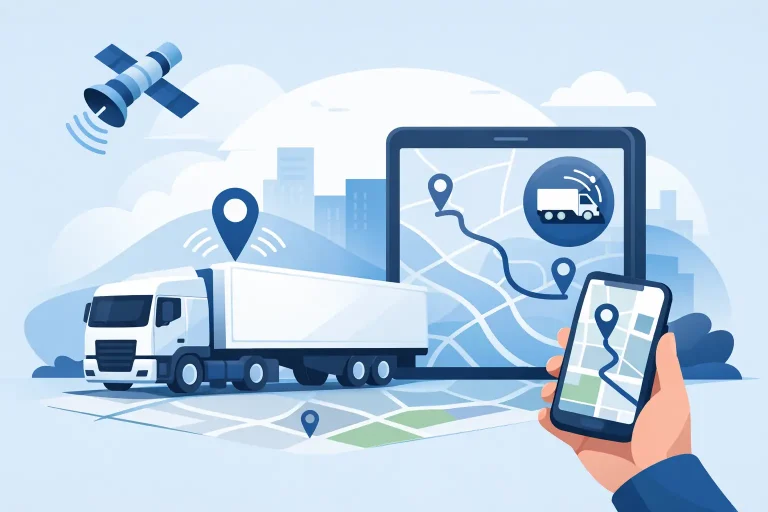
A trailer goes missing and the problem usually shows up twice – first in the yard, then in the day’s schedule. A missing plant trailer, flatbed or site unit can delay jobs, create awkward calls with customers and leave your team guessing who last moved it. That is where a trailer GPS tracking system stops being a nice extra and starts becoming a practical control tool.
For operations teams managing non-powered assets, trailers often sit in a blind spot. Prime movers and utes are tracked. Drivers are accounted for. But trailers move between depots, subcontractors, sites and storage yards with far less visibility. If you are relying on paper sign-outs, whiteboards or memory, it does not take much for asset location, utilisation and responsibility to become unclear.
Why trailer visibility matters more than most fleets expect
Trailers are easy to overlook because they do not generate engine data like vehicles do. But they still affect revenue, customer service and compliance. If a trailer is unavailable when it should be on site, your team may need to hire replacement equipment, reshuffle jobs or send staff to search for it. That creates cost well beyond the value of the trailer itself.
There is also the utilisation problem. Many businesses own more trailers than they think they need because they do not have reliable data on where assets are, how often they move or how long they sit idle. A trailer GPS tracking system helps answer simple but commercially important questions. Which trailers are active? Which ones are underused? Which sites keep holding assets longer than planned?
In industries like civil construction, plant hire, traffic management and trade services, those answers support better scheduling, tighter asset control and fewer avoidable purchases.
What a trailer GPS tracking system should actually do
At the basic level, the system should show where each trailer is and when it last moved. That sounds simple, but the difference between a useful system and a frustrating one comes down to how reliably it delivers that visibility.
For most trailer fleets, location alone is not enough. You also want movement history, geofence alerts, battery status where relevant, and a clear record of when the trailer entered or left a depot, customer site or restricted area. If your team is juggling multiple asset types, it also helps when trailers appear in the same platform as vehicles, plant and field staff rather than in a separate tool.
That single view matters more than many businesses realise. When data is split across systems, teams spend more time chasing updates and less time acting on them. A practical platform should make it easy to confirm asset location on desktop or mobile, respond quickly to exceptions and pull reporting without a drawn-out admin process.
Hard-wired or battery-powered? It depends on the trailer
This is where many buying decisions go wrong. There is no one-size-fits-all tracker for every trailer.
A hard-wired unit can be a strong fit when the trailer has a dependable power source and sees regular use. It usually supports consistent reporting and can suit assets that are critical to daily operations. But not every trailer is used often enough, or wired in a way that makes installation worthwhile.
Battery-powered trackers are often better for non-powered assets that sit for long periods, move irregularly or need a faster deployment option. They can be ideal for hire fleets, portable site assets and trailers that rotate between locations without much notice. The trade-off is that reporting frequency and battery life need to be matched carefully to how the asset is used. More frequent updates give you tighter visibility, but they also draw more power.
The right choice comes down to risk, movement patterns and operational value. A high-value trailer moving between public sites may justify more frequent location updates. A low-movement asset in controlled environments may not.
The real business case is bigger than theft recovery
Theft prevention is usually the first reason businesses look at trailer tracking, and for good reason. A trailer GPS tracking system can improve recovery chances, trigger movement alerts outside business hours and flag unexpected departures from a depot or site.
But if theft is the only outcome you are measuring, you may understate the return.
Most fleets see value in day-to-day operational control. Dispatch can confirm whether the right trailer is already near the next job. Admin teams can reduce time spent calling around to find equipment. Managers can review dwell time at customer sites and identify assets that are not turning over fast enough. Billing can become more accurate when trailer usage and site attendance are easier to verify.
For some businesses, that visibility also improves accountability with subcontractors and internal teams. When movement history is clear, disputes about handover times, location or responsibility are easier to resolve.
How trailer GPS tracking systems help mixed fleets
Many organisations are not managing trailers in isolation. They are managing vehicles, machinery, temporary site assets and people across multiple jobs at once. In that environment, adding a trailer tracker is only useful if it supports the wider operation.
A good trailer GPS tracking system should fit into the way your fleet already works. That means it should support mixed asset reporting, not force your team into separate workflows. If a transport coordinator can see the truck, the trailer and the destination status in one place, decisions get made faster. If maintenance teams can track service intervals across powered and non-powered assets, planning gets easier. If managers can review utilisation trends across all equipment, capital spend decisions become better informed.
This is where a solutions-led platform makes a practical difference. Eziway Tech, for example, focuses on visibility across all asset types rather than treating trailer tracking as a stand-alone add-on. For businesses running mixed fleets, that approach often makes adoption simpler and reporting more useful.
Common mistakes when choosing a trailer tracking setup
The first mistake is buying purely on device price. Low-cost hardware can look attractive until battery life, reporting reliability or platform usability start causing issues. If your team stops trusting the data, the system stops delivering value.
The second is over-specifying the solution. Not every trailer needs second-by-second tracking or advanced sensor inputs. Paying for more than the operation requires can make rollout harder to justify.
The third is ignoring implementation. Even the best technology falls flat if trailers are not assigned properly, naming conventions are inconsistent or alert settings are left too broad. Practical setup matters. Your team should know what each trailer is called in the system, who responds to alerts and what reports actually support decisions.
Support also matters more than people expect. If your operation spans multiple depots or remote sites, having direct, responsive help can save a lot of downtime and guesswork.
What to look for before you commit
Start with your operating reality, not the feature sheet. Ask how often each trailer moves, how critical it is to revenue, where it is typically stored and what kind of visibility gap is causing the most pain now. Some fleets need stronger theft deterrence. Others need better utilisation data or tighter customer-site accountability.
From there, assess the essentials. Can the system provide accurate, timely location updates? Can it support geofences and alerting that your team will actually use? Is the platform easy enough for operations staff, admin teams and managers to work with without constant training? Can it scale across trailers, vehicles and other assets if your needs expand?
It is also worth checking reporting quality early. The best systems do not just show dots on a map. They help you produce usable operational records, reduce manual admin and make decisions with more confidence.
A better trailer tracking decision starts with the problem
If you are considering a trailer GPS tracking system, the right question is not simply, “Which tracker should we buy?” It is, “What operating problem are we trying to fix?” When that is clear, the right setup is usually easier to identify.
For some businesses, the answer is recovering stolen or unauthorised assets faster. For others, it is about reducing downtime, improving utilisation, tightening handovers or getting mixed fleet visibility into one platform. The technology matters, but the outcome matters more.
When trailer tracking is matched properly to the way your operation actually runs, it does more than show where an asset is. It gives your team fewer unknowns, faster answers and one less thing to chase when the day is already full.