
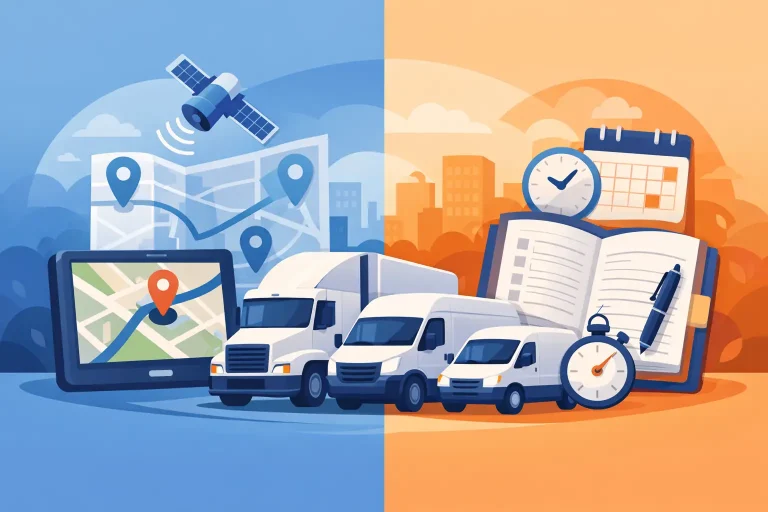
A vehicle leaves the yard at 5:42 am, stops at two unplanned sites, idles for 28 minutes, then finishes the day 60 kilometres away from where the paper logbook says it was. That gap is where costs, compliance risk and admin headaches usually start. When businesses compare GPS tracking vs logbooks, they are really asking a bigger question: how much visibility do we need to run the fleet properly?
For some operators, a handwritten or spreadsheet logbook still feels familiar. It is simple, low-cost and easy to explain. But once you are managing multiple vehicles, mixed assets, field staff or customer billing based on time and movement, the limits show up quickly. GPS tracking changes the conversation from what drivers remember to what actually happened.
GPS tracking vs logbooks: what is the real difference?
At a basic level, logbooks rely on manual entries. A driver or staff member records start times, finish times, kilometres, trip purpose, locations and sometimes vehicle checks. The system only works if entries are completed consistently and accurately.
GPS tracking records vehicle movement automatically. Depending on the setup, it can show live location, trip history, ignition events, idling, speeding, after-hours use, driver behaviour and asset utilisation. Instead of waiting for someone to fill in paperwork at the end of the day, the data is captured as the work happens.
That does not mean logbooks have no place. They can still support fringe benefits tax record keeping, private use declarations or specific compliance processes. But for day-to-day operations, the biggest difference is this: logbooks tell you what was written down, while GPS tracking tells you what occurred on the road, on site or in the field.
Where logbooks still work well
If you run a very small fleet with predictable routes and low reporting demands, logbooks may be enough. A business with one or two vehicles, limited private use and straightforward internal oversight can often manage with a disciplined paper or digital logbook process.
They are also familiar to finance teams and can be useful where a formal trip record is needed for tax or internal policy reasons. In those cases, the appeal is less about operational visibility and more about meeting a specific record-keeping requirement.
The problem is that most growing fleets are no longer that simple. Vehicles are shared across teams. Utes tow trailers. Plant moves between sites. Field staff start from home. Customers expect accurate arrival windows. Managers need to know not just where a vehicle was, but how efficiently it was used and whether it was operated safely.
Accuracy is where the gap becomes expensive
Manual logbooks depend on memory, effort and honesty. Even good staff can forget a stop, round a time, miss an odometer reading or write down the wrong job code after a long day. Those small errors add up.
In practical terms, poor data affects more than reporting. It can distort payroll inputs, customer invoices, utilisation reviews and maintenance planning. If a vehicle’s use is underreported, servicing may be delayed. If site attendance is unclear, disputes take longer to resolve. If kilometres are entered incorrectly, fuel and operating cost analysis becomes less reliable.
GPS tracking reduces those gaps because the core trip data is automatic. That matters for businesses that need confidence in job costing, vehicle accountability and utilisation. It also matters when a manager is trying to answer a simple question quickly, without chasing phone calls, paperwork or screenshots.
Compliance is not just about having records
A common mistake is thinking compliance is solved as long as a record exists. In reality, compliance depends on records being accurate, available and easy to verify.
Logbooks can tick the first box on paper, but they often create issues when records are incomplete, stored in different places or difficult to audit. If you need to investigate speeding complaints, after-hours use, route history, fatigue-related concerns or vehicle availability, manual records are usually too slow and too thin.
GPS tracking gives businesses a stronger audit trail. For fleets operating across construction, transport, community services or government work, that extra visibility supports more than location tracking. It helps show when assets moved, how long they were on site, whether they followed expected operating hours and whether there were patterns that need attention.
It depends, of course, on the compliance requirement. Some obligations still need signed declarations or formal documentation outside the telematics platform. But for operational compliance, GPS tracking gives managers a much firmer footing than logbooks alone.
Admin time is often the hidden cost
Paperwork rarely looks expensive until someone measures the hours around it. Drivers spend time filling in entries. Admin teams chase missing details. Supervisors correct errors. Managers piece together movements to respond to customer questions or internal disputes.
With logbooks, that work repeats every day. It also tends to bunch up at the end of the week or month, which is when inaccuracies rise and frustration follows.
GPS tracking removes a large share of that manual handling. Trip history, run sheets, travel times and utilisation reports are already there. Admin teams can focus less on collecting data and more on using it. For many businesses, that is the real operational gain – not just tracking vehicles on a map, but reducing the time spent proving what happened.
GPS tracking vs logbooks for mixed fleets and assets
This is where the comparison becomes more one-sided. Logbooks were designed around vehicles and driver-recorded trips. They are far less useful when you also need oversight of trailers, plant equipment, non-powered assets or subcontracted field activity.
A modern operation often includes far more than cars and trucks. You may have excavators moving between jobs, generators on long-term hire, traffic management equipment spread across locations, or trailers being shared between crews. A paper logbook does not give you much control over those assets unless someone is constantly updating separate records.
GPS and telematics platforms are better suited to that environment because they can extend visibility across different asset types. That gives operations teams a more complete picture of what is available, what is underused and what is overdue for maintenance or recovery.
The human factor matters
Some businesses hesitate because they worry GPS tracking will feel intrusive. That concern is understandable, especially when teams are used to managing their own run sheets or vehicle records.
The better approach is to frame tracking around outcomes that help everyone. Clearer dispatch, less paperwork, faster support when a vehicle breaks down, better proof of site attendance and more accurate timesheets all make day-to-day work easier. Safety is another factor. If a vehicle stops unexpectedly or a driver needs assistance, real-time visibility can make the response faster.
Good rollout matters here. Staff need to understand what is being tracked, why it is being used and how the data supports fairer, more consistent fleet management. When the system is easy to use and the purpose is clear, resistance usually drops.
When a hybrid approach makes sense
This is not always a straight choice between one and the other. In some fleets, GPS tracking and logbooks work best together.
For example, GPS can capture trip movement automatically while a driver still completes a required declaration for private use, pre-start checks or a specific compliance form. That keeps the operational data accurate without forcing the business to abandon records that still serve a legal or policy purpose.
For businesses transitioning from manual processes, a staged approach can also be the right move. Start with vehicle tracking for visibility and admin reduction, then layer in reporting, maintenance scheduling, driver behaviour monitoring or asset tracking as the operation is ready. That tends to be easier on teams and delivers value earlier.
So which one is better?
If your main priority is basic record keeping for a very small fleet, logbooks may still do the job. They are familiar and inexpensive to start with. But they come with ongoing labour, limited visibility and a higher risk of missing or unreliable data.
If your priority is operational control, accountability, faster reporting and better use of vehicles and assets, GPS tracking is the stronger option. It gives managers timely information instead of retrospective paperwork. It also scales far better as the fleet grows or becomes more complex.
That is why many organisations move past the question of GPS tracking vs logbooks fairly quickly once they see the day-to-day impact. The real decision is whether you want to manage by recollection or by evidence.
For fleet operators trying to cut paperwork, improve compliance and make better decisions without adding complexity, the right system should make the work feel simpler, not heavier. That is usually the point where manual logbooks stop being familiar and start becoming a bottleneck.