
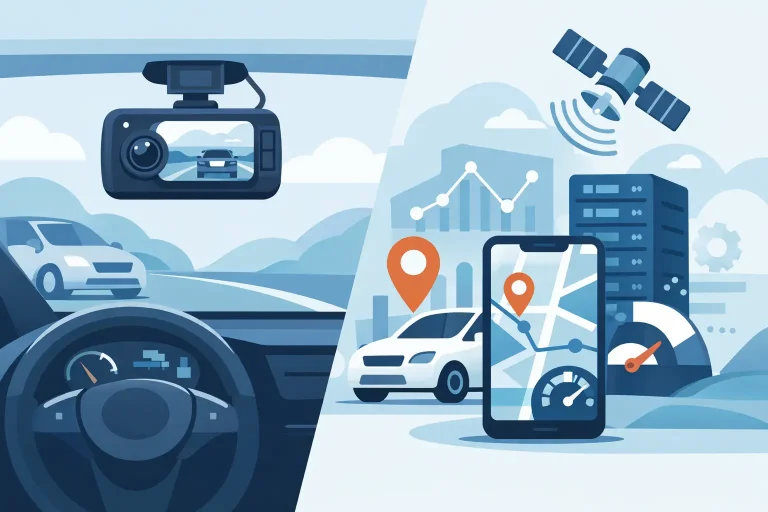
A driver brakes hard in traffic, a customer rings to question an arrival time, and payroll needs accurate run data by close of business. That is where the dash cams vs telematics question becomes practical very quickly. For most fleets, this is not a tech debate. It is a decision about safety, visibility, compliance and how much manual follow-up your team is still doing every day.
Dash cams vs telematics: what is the difference?
A dash cam records what is happening on the road and, depending on the device, inside the cab as well. Its main job is visual evidence. That can be useful after an incident, when reviewing a near miss, or when coaching a driver on risky behaviour such as distraction or tailgating.
Telematics does a different job. It collects and reports operational data from the vehicle or asset, such as location, speed, trip history, idling, kilometres travelled, engine hours, harsh driving events and in some cases maintenance or compliance information. Instead of showing you a video clip, it shows you what your fleet is doing, where it is, and how efficiently it is being used.
That difference matters because fleets often expect one system to solve problems it was not designed to solve. A dash cam can help prove what happened in a crash, but it will not automatically give you a clean picture of asset utilisation or service intervals. Telematics can show you repeated harsh braking events, but on its own it may not show whether a driver was cut off or looking at a mobile.
Why fleets often compare them in the first place
If you are managing utes, vans, trucks, plant or trailers, you are usually under pressure to improve safety while also reducing admin and controlling costs. Both technologies sound like they help with accountability, so they often end up in the same budget conversation.
The problem is that they answer different business questions.
If your main issue is disputed incidents, unsafe driving behaviour, or wanting a clearer view of what is happening behind the wheel, a dash cam can be the fastest way to add context. If your issue is missed jobs, inefficient routes, excess idling, uncertain asset locations or patchy reporting, telematics is usually the stronger operational tool.
For many organisations, the comparison is not really about choosing one over the other. It is about deciding what problem needs solving first.
Where dash cams add the most value
Dash cams are strongest when footage changes the outcome. That could mean defending a false claim, investigating an incident faster, or supporting driver coaching with actual examples rather than guesswork.
This is particularly useful in transport, civil construction, field services and community operations where vehicles spend long hours on the road and driver exposure is high. A clear record of road events can reduce time spent chasing statements, reviewing conflicting stories or dealing with unnecessary liability.
AI-enabled dash cams go a step further by detecting behaviours such as phone use, fatigue indicators, seatbelt non-compliance or following too closely. That turns the camera from a passive recorder into an active safety tool. Even then, there is a trade-off. More footage and more alerts can create more review work if the system is not configured properly or if the business does not have a clear process for follow-up.
Dash cams also have limits. They do not always tell you how a vehicle is being utilised across the week, whether routes are efficient, or which assets are underused. They give you evidence and context, not a full fleet operating picture.
Where telematics adds the most value
Telematics is built for day-to-day fleet control. It helps answer questions that operations teams ask constantly. Where is the nearest vehicle? How long has that unit been idling? Did the driver actually arrive on site? Which plant has not moved in three days? When is the next service due?
That visibility has a direct effect on efficiency. Dispatch becomes easier, billing can be more accurate, timesheets and run sheets can be checked against actual activity, and maintenance can be scheduled based on usage rather than guesswork. Over time, that usually means less paperwork, fewer avoidable delays and better uptime.
Telematics is also more useful for trend management. One harsh braking event on its own may not mean much. A pattern of speeding, harsh cornering and excessive idling across a month tells you where fuel, wear and safety risk are building up. That is where coaching and policy changes become more targeted.
For mixed fleets, telematics also tends to be more flexible. You can track powered vehicles, plant equipment, trailers and non-powered assets using different device types in one platform. That matters when your operation is not just a line of trucks but a combination of vehicles, machinery and field activity.
Dash cams vs telematics for safety
If safety is the top priority, it depends on what kind of safety outcome you are chasing.
Dash cams are better at showing the moment. They provide context around incidents and can improve driver coaching because there is less ambiguity. Drivers can also benefit when footage clears them of fault.
Telematics is better at showing the pattern. It helps identify repeat behaviours and high-risk trends before they lead to a major event. Speeding hotspots, long driving hours, frequent harsh events and route-based risks are easier to monitor at scale through telematics reporting.
The strongest safety programs usually use both. Telematics highlights the pattern, and dash cam footage explains the event. Together, they support fairer investigations and more useful coaching.
Dash cams vs telematics for compliance and admin
This is where telematics usually has the edge.
A camera may support an investigation, but telematics is what reduces manual fleet admin across the week. Trip logs, vehicle usage records, maintenance reminders, utilisation data and location history all feed into better reporting and cleaner operational processes. For businesses handling contractor movements, site attendance, service delivery or chain-of-responsibility pressures, that visibility becomes more than convenient. It supports compliance and accountability in a way spreadsheets rarely do.
That said, video can still play a compliance role. If your policies cover mobile phone use, seatbelts or distraction, camera-based alerts can support enforcement and coaching. The key is to avoid treating footage as your main reporting system. It is evidence, not workflow.
Should you choose one or both?
If budget means you need to start with one, choose the system that addresses your biggest operational pain first.
Start with dash cams if your business is dealing with frequent driving incidents, customer complaints about on-road behaviour, or a need for stronger driver accountability. They can deliver a fast return when a single disputed event would otherwise cost significant time or money.
Start with telematics if your operation needs better visibility, less paperwork, improved dispatch, cleaner utilisation data or stronger maintenance control. For many fleets, this creates broader value across the business because it affects safety, efficiency, service delivery and cost control at the same time.
Add both when your fleet is large enough, exposed enough, or busy enough that data without context is not enough and footage without operational reporting is too narrow. That is often the tipping point for growing fleets and organisations managing varied assets across multiple crews or locations.
What to ask before making the call
Before you commit, ask what decisions the system needs to improve. That sounds simple, but it changes the buying process.
If you need to know where assets are, how they are used, when they need servicing and whether teams are actually following planned routes or schedules, telematics should be the foundation. If you need to understand what happened in specific road events and want direct coaching tools around driver behaviour, cameras become more valuable.
Also ask who will use the system every day. A tool that looks impressive but adds review time or requires constant manual checks can create a new admin problem. The best setup is one that gives operations managers, fleet managers and admin staff the visibility they need without making the process harder.
For Australian and New Zealand fleets dealing with mixed assets, mobile teams and practical compliance pressures, simple deployment and local support also matter more than many businesses expect. Good technology is only useful when your team can actually use it consistently.
At Eziway Tech, that is why fleet solutions work best when they are matched to the job, not sold as a one-size-fits-all answer.
The real question is not whether dash cams or telematics are better. It is which one will remove the most friction from your operation right now, and whether combining both will give your team a clearer, fairer and more efficient way to run the fleet tomorrow.